


African churches opened their doors in London from the 1960s,
followed by a second wave in the 1980s. Migrants, many of them from
Nigeria and Ghana, sought to build communities and maintain
cultural connections with their home countries by founding their
own churches, often in private homes, schools and office
spaces.
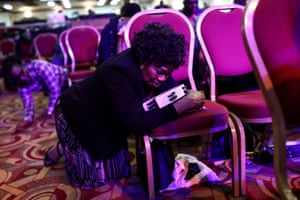
- A worshipper kneels to pray during a Sunday service at the
House of Praise church in Camberwell, south London
On a cold, grey Sunday morning, in a street lined with shuttered
builders’ yards and storage units, songs of prayer in the West
African language of Yoruba ring out from a former warehouse
that is now a church. The congregation, almost entirely dressed in
white robes, steadily grows to around 70 people as musicians
playing drums, a keyboard and a guitar pick up the pace of the
hymns. Some women prostrate themselves on the floor in prayer. In
the sparse formerly industrial building, its interior brightened by
touches of gold paint, a speaker reminds the group of a list of
banned activities – no smoking, no drinking of alcohol, no
practicing of black magic.
The New Jerusalem Parish
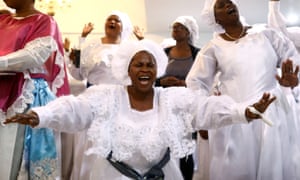
- Worshippers sing as they offer thanksgiving during Sunday
service at the New Jerusalem Parish in New Cross, south London
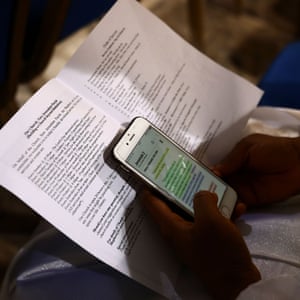
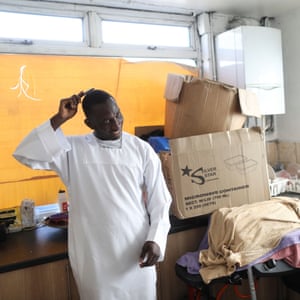
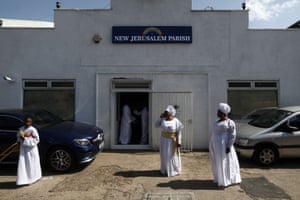
- Top: a worshipper reads a passage from the Bible on her
smartphone during Sunday service; a worshipper combs his hair
before attending service. Above: worshippers leave after Sunday
service
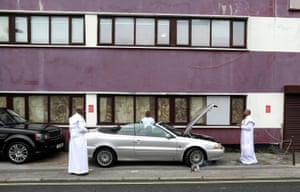
- Worshippers bless a vehicle to keep it safe after a member of
the congregation had a revelation during Sunday service
In a street outside, a pastor flicks holy water over the car of
a woman who wants a blessing to ward off the risk of accidents. The
busy scene at the Celestial Church of Christ is repeated at a half
a dozen other African Christian temples on the same drab street and
in the adjacent roads – one corner of the thriving African church
community in south London.
Around 250 black majority churches are believed to operate in
the borough of Southwark, where 16 percent of the population
identifies as having African ethnicity.
Southwark represents the biggest concentration of African
Christians in the world outside the continent with an more than
20,000 congregants attending new black majority churches each
Sunday, according to research conducted in 2013 by
the University of Roehampton.
Reflecting the different waves of migration to Britain in the
20th Century, these African places of worship followed the
Caribbean churches that appeared in the late 1940s and 1950s as
workers and their families arrived from Jamaica and other former
British colonies.
The House of Praise
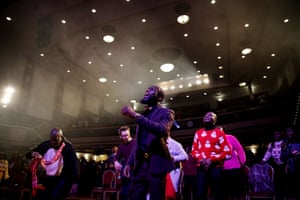
- Worshippers dance during ‘Super Sunday’ service at the House of
Praise church. The church, formerly a theatre and bingo hall, is
one of the biggest in south London. The services, mainly attended
by worshippers of Nigerian descent, are recorded using television
cameras
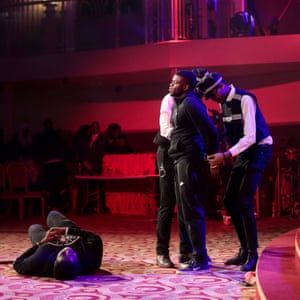
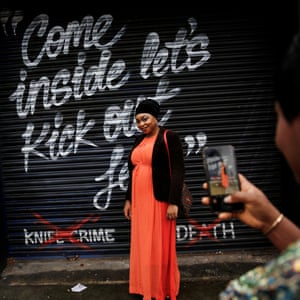
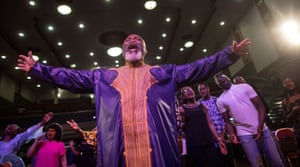
- Top: Members of the youth church perform in a knife crime play
during a Good Friday performance; a worshipper takes photos after
the ‘Super Sunday’ service. Above: worshippers pray during Sunday
service
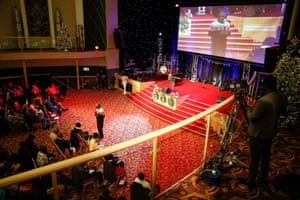
- A television cameraman films Pastor Andrew Adeleke as he
addresses the congregation during the ‘Super Sunday’ service
As the African communities grew, the churches moved into bigger
spaces in bingo halls, cinemas and warehouses, gathering
congregations of up to 500 people where services are streamed
online by volunteers with video cameras.
There is a striking contrast with the empty pews at many
traditional Church of England churches where congregations
have dwindled for years.
“We pray for this country,” said Abosede Ajibade, a 54-year-old
Nigerian who moved to Britain in 2002 and works for an office
maintenance company.
“People here brought Christianity to Africa but it
doesn’t feel like they serve Jesus Christ any more.”
The Apostles Of Muchinjikwa Christian
church
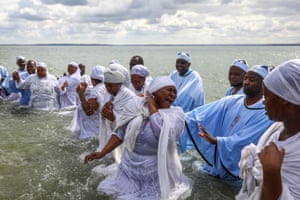
- A mass baptism on the beachfront in Southend-on-Sea. Members of
the church travel to Southend-on-Sea from all over the country,
some from as far as Scotland, to join members from London, Leeds
and Leicester for an annual ceremony
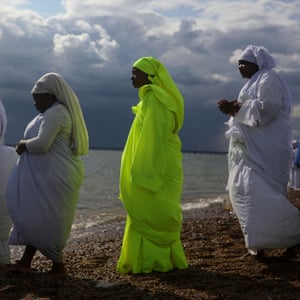
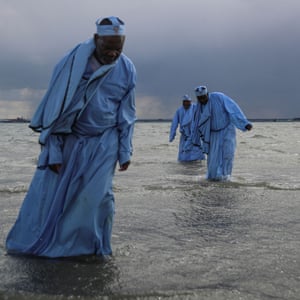
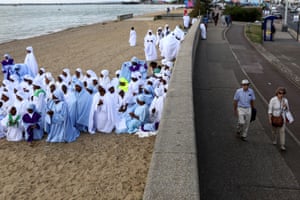
- Top: members prepare to enter the sea for a mass baptism;
senior members leave the sea after the ceremony. Above: locals walk
along the seafront as members worship
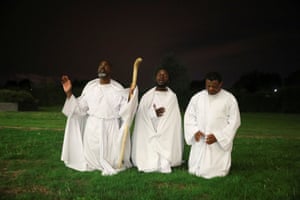
- Members pray outside the Basildon Sporting Village before the
mass baptism
Anyone travelling through south London on a Sunday morning will
see worshippers, often dressed in dazzlingly coloured African
clothes, making their way to churches, each with their different
styles of worship.
Hymns are sung only in African languages in some temples, or
only in English at others. Some pastors arrange for worshippers to
take full immersion baptisms in the cold of the English Channel.
Others believe that when congregants suddenly start speaking in
unknown languages it marks the presence of the Holy Spirit.
The Eternal Sacred Order of Cherubim &
Seraphim Church
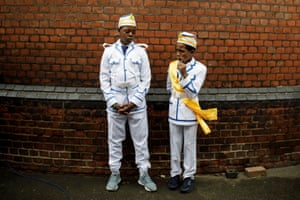
- Young members wait to parade through the streets to celebrate
their annual Thanksgiving in Elephant and Castle. The church was
founded by Moses Orimolade Tunolase in 1925 in Nigeria and is
attended by worshippers of Nigerian descent who come from all over
the country for services
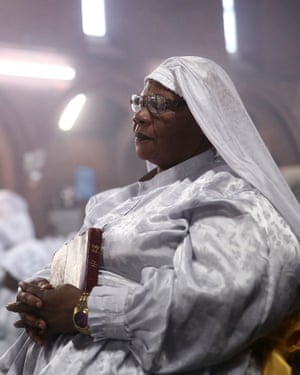
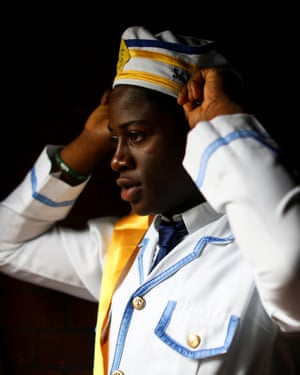
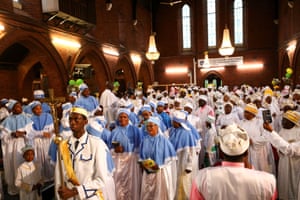
- Top: a worshipper prays during a Good Friday Lent service; a
boy adjusts his hat at the annual Thanksgiving. Above: members sing
as they celebrate Thanksgiving
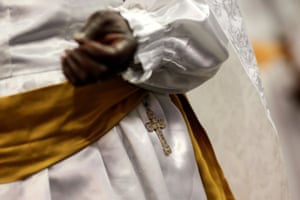
- A cross hangs from the waist of a worshipper as she prays
during an Easter Sunday service
The research by the University of Roehampton found that many
churches have in common a drive for professional advancement, a
commitment to spend three hours or more at Sunday service and
typically very loud worship.
“That is how we express our joy and gratitude to God,” Andrew
Adeleke, a senior pastor at the House of Praise, one of the biggest
African churches in Southwark, in a former theatre.
“The church is not supposed to be a graveyard,” Adeleke said.
“It is supposed to be a temple of celebration and worship and the
beauty is to be able to express our love to God, even when things
are not perfect in our lives.”
For some, the noise from amplified services is a problem,
leading to complaints to local authorities from residents. But many
churches face bigger challenges than unhappy neighbours: some
provide food for people struggling to make ends meet, or work with
young people at risk of recruitment by gangs.
Andrew Rogers, senior lecturer in Practical Theology at the
University and author of the research paper, Being
Built Together[1],, said pastors had to
juggle retaining the churches African identity while appealing to
children of first generation immigrants, many of whom have never
lived outside Britain. They typically have a more liberal world
view which can be hard to reconcile with conservative Pentecostal
teachings.
Rogers recalled speaking to one pastor who lamented he was
unable to talk about religious miracles to his children.
“If the church doesn’t adapt, then they are going to leave and
look elsewhere,” Rogers said.
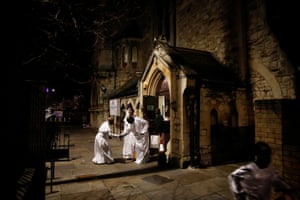
- Worshippers leave after a night-time Christmas Eve service at
the Celestial Church of Christ in Elephant and Castle
References
- ^
Being Built Together
(www.roehampton.ac.uk)