Mon. May 25th, 2026
Spread the love
The demand from the Abrams campaign comes in response to an Associated Press report on records it obtained showing Georgia has put a hold on more than 53,000 voter registration applications — nearly seven-in-ten of them belonging to African Americans — because they failed to clear the state’s “exact match” standard.

Under the policy, even the most minor discrepancy — like a typo or missing letter — between a voter’s registration and their drivers license, social security or state ID cards can be flagged.

“As he has done for years, Brian Kemp is maliciously wielding the power of his office to suppress the vote for political gain and silence the voices of thousands of eligible voters — the majority of them people of color,” Abrams spokeswoman Abigail Collazo said in a statement.

Collazo pushed for Kemp to step down “so that Georgia voters can have confidence that their Secretary of State competently and impartially oversee this election.” Georgia Democrats were rebuffed when they made a similar request earlier in the year.

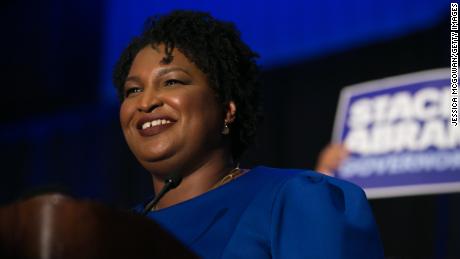
Kemp’s campaign maintains voters whose names were tied up in the system would still be able to either sort out the documentation at elections sites or, if not, cast provisional ballots. It also touted the state’s growing rolls, saying they were likely to surpass 7 million once the final numbers came in following Tuesday’s registration deadline.

“While outside agitators disparage this office and falsely attack us, we have kept our head down and remained focused on ensuring secure, accessible, and fair elections for all voters,” Kemp said in a statement. “The fact is that it has never been easier to register to vote and get engaged in the electoral process in Georgia, and we are incredibly proud to report this new record.”

Abrams, who became a national Democratic star during her primary campaign, is vying to become the first black woman elected governor in any state. She is running neck-and-neck with Kemp, with most recent polling and analysis predicting a toss-up on Election Day. Republicans have held the governor’s mansion in Georgia since 2003.

The current occupant, Gov. Nathan Deal, will leave office next year after serving the maximum two terms.

Kemp also placed blame on the New Georgia Project, which was founded by Abrams when she was the Georgia House minority leader, and ahead of the 2014 elections set out to sign up 800,000 new young and minority voters.

Kemp responded to the influx of new applications that year by launching an investigation into its practices. No allegations of wrongdoing were ever brought directly against the group and Abrams, her campaign said, is no longer involved in its activities.

In a tweet on Wednesday night, Kemp again sought to place the onus for the flagged registrations on the New Georgia Project, saying it had “submitted sloppy forms.”

“Now, (the Abrams campaign is) faking outrage for political gain,” he wrote, insisting that the “53,000 Georgians on our ‘pending’ list can vote in the Nov. 6th election.”

Throughout the day on Wednesday and into Thursday, Georgia Democrats ramped up efforts via social media and other channels to promote their “Voter Protection Hotline.” The state party in February became the first in the nation to hire a full-time internal elections watchdog.

Kemp has also come under fire from voting rights advocates for canceling more than a million “inactive” voters from Georgia’s rolls since becoming the state’s chief elections officer in 2010. The practice was upheld by the Supreme Court in a 5-4 ruling in June. The state purged a total of 1.5 million voters between the 2012 and 2016 elections, according to a report from the Brennan Center for Justice.

The “exact match” system was used by Kemp’s office from 2013 to 2016, during which nearly 35,000 applications were rejected, with minorities disproportionately affected, according to a lawsuit that was settled in 2017. That agreement seemed to put an end to the practice, but the GOP-held legislature quickly embedded it in new legislation.

Update: The headline and story have been updated to reflect that the Abrams for Governor Campaign told CNN after publication that the campaign was calling for Brian Kemp’s resignation as Secretary of State, not the candidate herself.


CNN

By admin

You missed

From Tramadol to Canadian to Exol-5 The New Drug Destroying Nigerian Youths An Investigative Article .From Tramadol to Canadian to Exol-5: The New Drug Destroying Nigerian Youths An Investigative Report on the Shifting Landscape of Substance Abuse in Nigeria Nigeria faces a severe and evolving drug crisis, particularly among its youth. What began with the widespread abuse of Tramadol has progressed through mixtures like “Canadian” to newer pharmaceutical diversions such as Exol-5. This shift reflects deeper issues: easy access to prescription drugs, weak regulation, socioeconomic pressures, and aggressive street-level marketing. NDLEA operations and health studies reveal a public health emergency that threatens an entire generation. Phase 1: The Tramadol Epidemic (2010s–Early 2020s) Tramadol, a synthetic opioid prescribed for moderate to severe pain, became Nigeria’s most notorious street drug. Cheap, potent, and widely smuggled (often from India and other Asian countries), it offered users energy, euphoria, and pain relief — appealing to commercial drivers, laborers, students, and young men seeking confidence or stamina. Scale of the Problem: Millions of tablets seized annually by NDLEA. High prevalence among young males aged 15–35. Linked to increased crime, sexual violence, organ damage (kidney failure, seizures), and mental health breakdowns. Contributed to broader opioid misuse alongside codeine cough syrups. Government responses included tighter import controls and public awareness campaigns, but these only displaced demand to other substances rather than eliminating it. Phase 2: The Rise of “Canadian” (Mid-2020s) “Canadian” or “Canadian Loud” emerged as a popular code for high-grade cannabis (often indica-dominant strains) or cannabis mixed with other synthetics. It gained traction as users sought alternatives or combinations to Tramadol’s effects. This phase marked a move toward imported or locally cultivated premium weed, sometimes laced with stronger chemicals. Youths in urban centers like Lagos, Kano, Jos, and Onitsha embraced it for its perceived “cleaner” high compared to opioids. However, it fueled polydrug use — combining cannabis with opioids, sedatives, or alcohol — amplifying health risks. Phase 3: Exol-5 – The Current Threat (2024–2026) Exol-5 (Benzhexol Hydrochloride / Trihexyphenidyl 5mg), originally a prescription medication for Parkinson’s disease and drug-induced movement disorders, has become the latest pharmaceutical being heavily abused. Why Exol-5? Euphoric Effects: Users report intense euphoria, hallucinations, and a sense of detachment — making it attractive as a cheap “upper” or escape. Accessibility: Sold over-the-counter or on the black market despite being a controlled prescription drug. NDLEA has seized millions of pills in single operations (e.g., 3.1 million pills in Kano in late 2024, and over 5.6 million combined with Tramadol in other busts). Street Names: Exol, Artane, Benzhexol, “Farin Mallam” (in Northern Nigeria). Demographics: Prevalent among youths, laborers, and even psychiatric patients who divert prescriptions. Studies show abuse rates as high as 25% among certain outpatient groups. Health Consequences: Anticholinergic toxicity: Confusion, dry mouth, blurred vision, urinary retention, constipation, and in high doses — delirium, psychosis, seizures, and heart issues. Long-term: Cognitive impairment, addiction, exacerbated mental health disorders. Often mixed with Tramadol, codeine, or cannabis, creating dangerous synergies. In cities like Jos, Exol-5 sits alongside diazepam, Rohypnol, and Tramadol on street markets, easily available to teenagers and young adults. Why This Evolution Continues Supply-Side Failures: Porous borders, corrupt officials, and overproduction of pharmaceuticals enable diversion. Demand Drivers: Unemployment, poverty, peer pressure, trauma, and the pursuit of performance enhancement (e.g., for “hustle” culture). Weak Regulation: Many pharmacies sell restricted drugs without prescriptions. Online and street vendors fill gaps. Displacement Effect: Cracking down on one substance (Tramadol/codeine) pushes users and dealers toward the next available option. NDLEA reports ongoing large seizures, but the problem persists due to high profitability and low risk for mid-level distributors. Broader Impacts on Nigerian Youths Education: Increased dropout rates and poor academic performance. Mental Health: Rising cases of psychosis and depression. Economy: Lost productivity among the working-age population. Crime and Violence: Drug-fueled robberies, cultism, and family breakdowns. Public Health System Strain: Overburdened hospitals treating overdoses and chronic complications. Young people aged 15–39 remain the hardest hit, with national surveys showing drug use prevalence significantly above global averages. What Must Be Done Stronger Enforcement: Consistent prosecution of corrupt enablers and large-scale traffickers. Regulation: Crackdown on rogue pharmacies and better tracking of prescription drugs. Prevention & Rehabilitation: School programs, community outreach, and expanded treatment centers (currently woefully inadequate). Economic Alternatives: Address root causes like youth unemployment. Public Awareness: Honest campaigns highlighting real dangers of “Exol-5” and similar drugs. Conclusion From Tramadol’s opioid grip to “Canadian” cannabis culture and now Exol-5’s anticholinergic highs, Nigeria’s drug crisis is mutating faster than responses can contain it. Exol-5 represents the dangerous new frontier — a legitimate medicine turned youth destroyer due to misuse and greed. Without urgent, multi-layered intervention — combining supply disruption, demand reduction, and socioeconomic support — an entire generation risks being lost to addiction. The time for half-measures is over. Nigeria’s future depends on winning this fight.